Why Bolt-On AI Tools Don't Work for Insurance Agencies (And What Does)
Martin Naude
Most agencies experimenting with AI run into the same wall pretty fast.
You get excited about a tool. Maybe it's Copilot, maybe it's ChatGPT. It writes well, it summarizes well, it seems capable. Then you ask it to do something real: draft a renewal email for a commercial client, pull up what's expiring next month, flag accounts that haven't had any activity, and it stares back at you blankly. Not because it isn't smart, because it has no idea who your clients are.
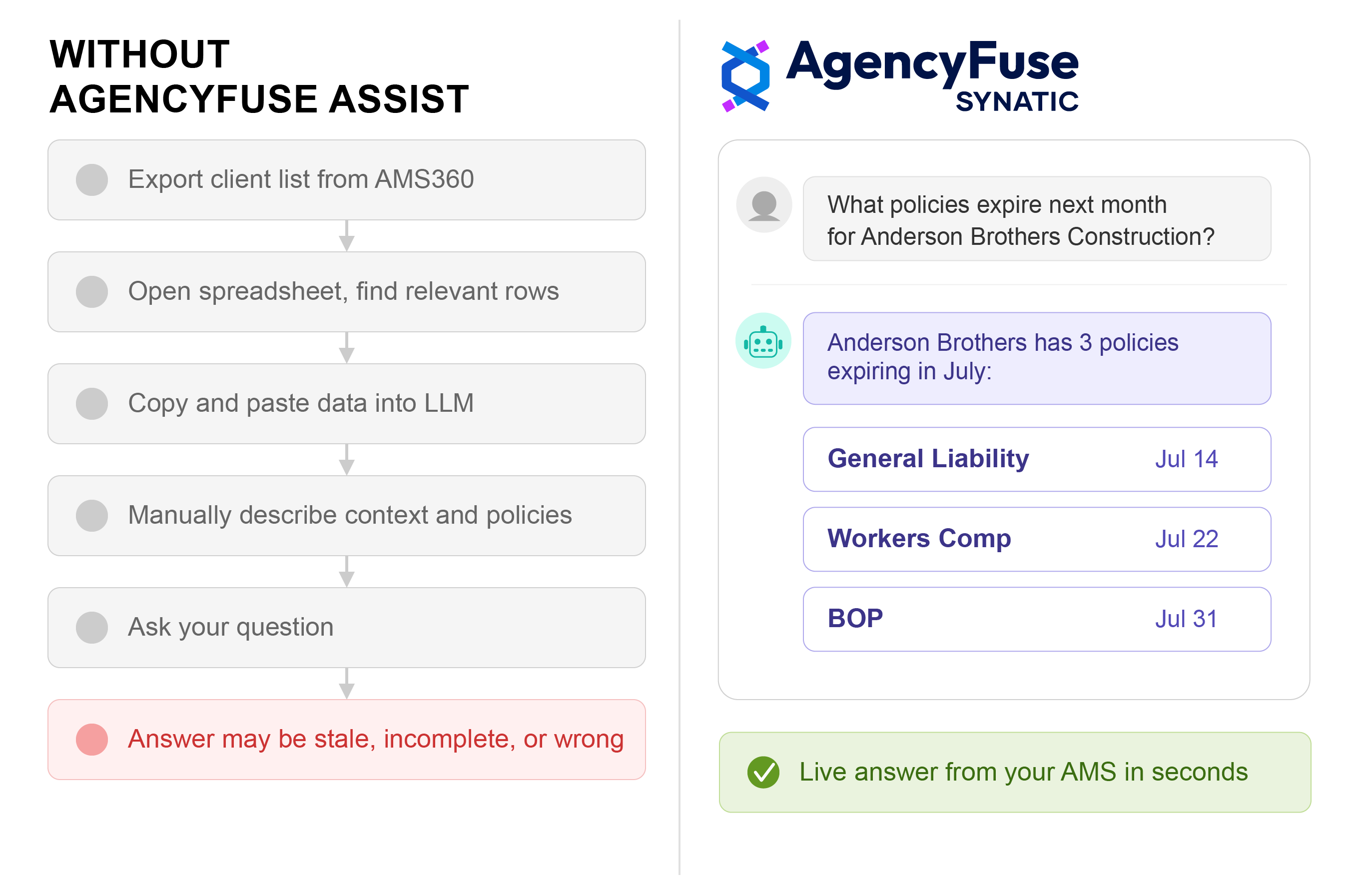
Your customers, policies, claims, and activities all live inside your Agency Management System (AMS). Your AI tools live somewhere else. That gap is the whole problem, and most agencies try to solve it by doing more manual work: copying and pasting data, describing policies by hand, summarizing notes before handing them off to the model. That's not AI helping your agency. That's you doing extra work so AI can exist in the same room as your data.
AgencyFuse was built to close that gap entirely.
The problem with point solutions
Most AI tools were designed for general productivity. They weren't designed for an AMS. They don't know what an "expiration date" means in context, they don't understand the difference between a policy shell and a bound policy, and they definitely don't know what's in your book of business.
Adding a bolt-on integration doesn't fix this. It creates a narrow, brittle connection that breaks when the underlying system changes, requires ongoing maintenance, and usually only surfaces a fraction of the data that's actually relevant.
The only way to make AI genuinely useful in an agency is to give it real, governed access to the data your agency actually runs on, not a filtered export, not a copy-paste, not a summarized version. The live data, in context, with the right controls in place.
That's what we built.
A platform designed around your data
AgencyFuse connects to the systems your agency runs on: AMS360, Applied Epic, Sagitta, Hawksoft, QQCatalyst, AgencyBloc, NowCerts, and more. We've spent years translating the different dialects each of those systems speaks into a single, consistent picture of your agency.
Every AgencyFuse solution draws from that same live data layer. There's no syncing, no exports, no lag. When something changes in your AMS, it's reflected immediately across the platform.
That foundation is what makes everything else possible.
The solutions built on top of it
AgencyFuse Correct keeps your AMS data clean. Duplicate records, missing fields, outdated contacts — these compound quietly over time and undermine everything downstream, including AI. Correct identifies and resolves data quality issues at the source, so the foundation the rest of the platform depends on stays solid.
AgencyFuse Connect is the integration layer. It bridges your AMS with the carriers, tools, and platforms your agency depends on. Because it sits on top of the unified data layer, it doesn't have to be rebuilt for each system — it inherits the translation work already done.
AgencyFuse Match automates commission statement reconciliation. Upload a PDF commission statement, and Match extracts the transaction data, maps it intelligently, auto-matches to your AMS policies, and produces an AL3 file ready for import — in minutes, without anyone doing it by hand.
All three do real work. None of them require you to think about the data layer underneath. It's just there, and it's what makes them reliable.
Where AI becomes something you can actually converse with
The three solutions above automate work that used to be manual. AgencyFuse Assist does something different: it gives your entire team a conversational interface into your book of business.
CSRs, account managers, and producers can ask questions in plain English and get answers pulled live from the AMS. No report builder. No developer tools. No lookup.
"What policies expire next month for Anderson Brothers Construction?" Assist returns a real answer in seconds.
"How much new business have we written this quarter, by producer?" Same thing.
It goes further than pre-built queries, too. A producer can ask something the platform was never explicitly designed to answer like, "Show me all commercial customers in Travis County with a GL policy expiring in the next 90 days who haven't had an activity logged this quarter," and Assist will query this against your live data to return relevant results.
That's the difference between a search box with AI bolted onto it and something that actually functions as an analytical partner.
Assist also works with the AI tools your team already uses. If your producers prefer Copilot and your service team prefers Claude, both connect to the same data layer with the same permissions to deliver consistent results. You don't have to pick a side or retrain anyone.
Security that matches the sensitivity of the data
Insurance data is not generic business data, and the security model reflects that.
Every staff member's AI assistant inherits the same permissions they have in the AMS. A CSR can't suddenly query data they couldn't otherwise access. A producer's agent only sees that producer's book. Fine-grained controls determine which fields - SSNs, payment information, internal notes - are visible or invisible to the AI.
Authentication is backed by Auth0, with full support for SSO, MFA, and the access controls your IT team expects. This isn't a layer added after the fact. It's how the platform was designed.
The gap has always been the data
AI in insurance has mostly been impressive on stage and frustrating in production. The models are capable. The missing piece has always been accessing the data that actually runs the business, with the controls in place to do it safely.
AgencyFuse closes this gap. Your AMS is no longer a silo your AI tools have to work around. It's a first-class part of your stack, and Assist is the most direct expression of what that makes possible.
If you want to see what AgencyFuse can do for your agency, book a demo with us and we'll show you.